
Short-form video is no longer a trend brands can afford to monitor from a distance. It has become one of the primary ways consumers discover products, evaluate services, and decide who they want to buy from. But as Instagram Reels and TikTok both compete for the same audience attention and brand budgets, the question for marketers has become more nuanced than “which platform is bigger?” The real question is: which one is right for your specific business goals?
The honest answer is that it depends. Both platforms offer distinct advantages, and understanding those differences is what separates brands that grow from brands that simply post.
Why Short-Form Video Dominates in 2026
Consumer behaviour has shifted in a way that is difficult to overstate. Mobile-first content consumption is the default now, not an emerging trend. People open their phones for entertainment, for product research, and increasingly to make purchasing decisions, all within the same scrolling session.
Social commerce is accelerating this further. TIndustry analysts estimate TikTok Shop generated approximately US$66 billion in global GMV during 2025, with several market forecasts projecting continued growth through 2026. Instagram continues to be one of the world’s leading social commerce platforms, supported by integrated shopping features, creator partnerships, and in-app product discovery.
Creator-led marketing has also shifted from a supplementary tactic to a core strategy for brands across categories. Audiences trust people they follow more than they trust brand accounts. That dynamic is not changing.
Understanding the Core Differences

Before comparing performance metrics, it helps to understand what makes each platform structurally different.
Instagram Reels sits inside a broader ecosystem. Users on Instagram also browse photos, Stories, carousels, and DMs. Reels compete for attention within that ecosystem, which means content needs to earn its place against multiple formats. The algorithm weights existing follower relationships more heavily, and content discovery tends to be more gradual and community-led.
TikTok was built entirely around video discovery. Its For You Page (FYP) does not prioritise who users follow. It prioritises how users behave, watch time, replays, shares, and completion rate. This means a brand account with 200 followers can reach 200,000 viewers with a single strong video. That discovery mechanic has no real equivalent on Instagram.
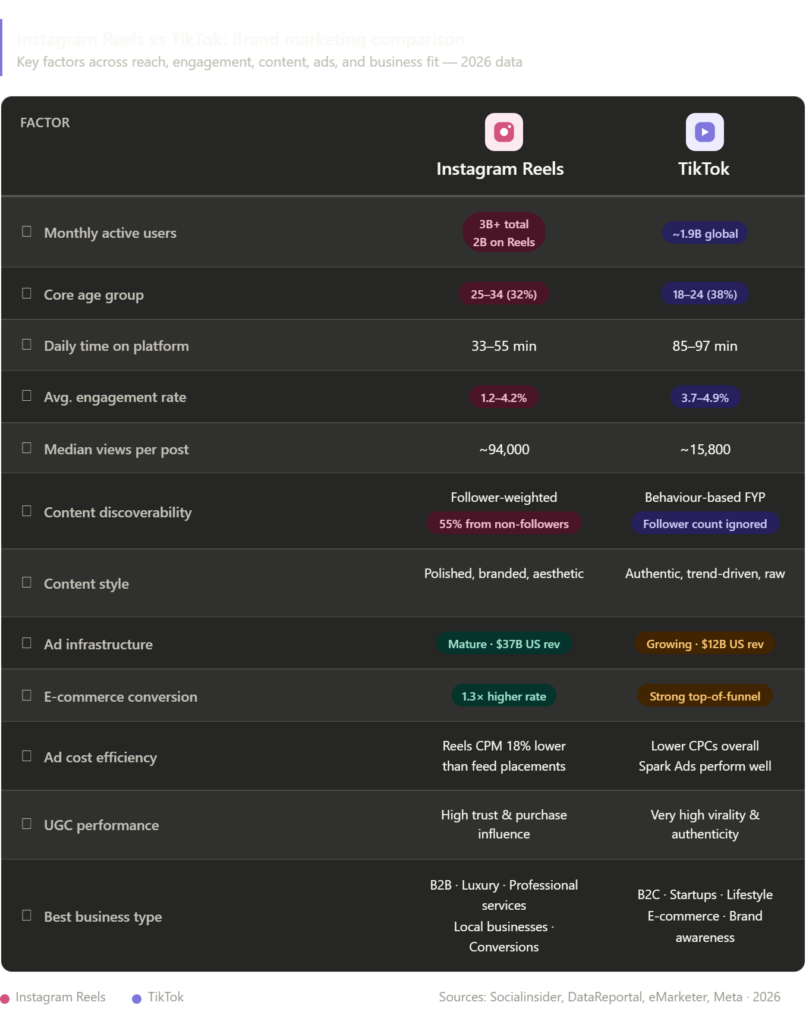
The demographic split matters too, though the gap has narrowed. TikTok’s largest user segment is 18 to 24 year olds (38% of its base). Instagram’s largest segment is 25 to 34 year olds (32%). Both platforms have grown significantly across the 30 to 45 demographic, so assuming TikTok is “just for Gen Z” is outdated at this point.
Instagram Reels vs TikTok Marketing: A Detailed Comparison
Audience Reach
Instagram has over 3 billion monthly active users globally, with more than 2 billion engaging with Reels monthly. TikTok has reached approximately 1.9 billion monthly active users. Both platforms deliver scale, but the reach mechanics differ.
Reels achieve an average reach rate of around 30.81%, with 55% of views coming from non-followers, making it a solid discovery format within the Instagram ecosystem. TikTok’s discovery is more aggressive for new content by design, but median views on Reels (around 94,000 per post) are reported higher than TikTok’s (around 15,800), partly because Reels are distributed across both Instagram and Facebook simultaneously.
For local market reach, Instagram tends to maintain a stronger foothold in professional and older demographics. TikTok offers faster access to younger, high-engagement audiences globally.
Content Style
The content cultures on each platform are genuinely different, and brands that ignore this consistently underperform.
TikTok rewards participation in platform culture. Trending sounds, formats, challenges, and native humour are part of the vocabulary. Content that feels corporate or overly produced tends to be ignored. Authenticity is not just preferred, it is algorithmically rewarded.
Instagram Reels, by contrast, rewards content that fits the platform’s more polished aesthetic. Text overlays, clear calls to action, and visually consistent storytelling tend to perform well. Educational content, before-and-after formats, and branded visual identity translate more naturally here.
Copying content from one platform to the other without adapting it is one of the most common and costly mistakes brands make. Each platform reads the same video through a completely different cultural lens.
Engagement

TikTok maintains a higher average engagement rate, typically in the 3.7 to 4.9% range depending on account size and niche. Instagram Reels ranges from approximately 1.2 to 4.2%. For nano-influencers with under 10,000 followers, both platforms are closer in performance (8.1% TikTok vs 7.9% Reels). The gap widens significantly at larger account sizes.
However, engagement type matters as much as engagement rate. Instagram’s algorithm now heavily weights saves and shares, which are strong indicators of purchase intent and long-term brand recall. TikTok engagement tends to be higher volume but slightly less correlated with downstream conversion.
Advertising Opportunities
Instagram’s advertising infrastructure is more mature. It generates roughly $37 billion in US ad revenue versus TikTok’s $12 billion. Many advertisers report Reels campaigns achieving competitive CPMs and stronger engagement than traditional feed placements, although results vary by industry and campaign objectives.
TikTok’s Spark Ads, which boost organic content rather than running standalone paid ads, consistently outperform standard in-feed placements because social proof signals credibility to new viewers. TikTok also offers lower overall CPCs, making it attractive for brands looking to maximise reach efficiently.
For e-commerce conversion, Instagram Reels deliver 1.3 times higher conversion rates than TikTok ads, which matters if the goal is direct sales rather than awareness.
Brand Building and Lead Generation
Instagram is generally stronger for B2B brands, professional services, and businesses where trust and credibility drive decisions. The platform’s more structured content environment, combined with DM automation capabilities and shopping integration, makes it effective for moving people from awareness to consideration to conversion within one ecosystem.
TikTok is more effective for B2C brands, particularly those targeting younger consumers in lifestyle, beauty, food, entertainment, and e-commerce. The platform’s discovery dynamics make it excellent for rapid brand awareness among audiences who might never have searched for the brand organically.
The Role of UGC in Both Platforms
User-generated content has become one of the most influential forces in short-form video marketing. On both TikTok and Instagram, content that looks like it was made by a real person rather than a marketing team consistently outperforms polished brand content.
Partnering with UGC Content Creators in UAE and across the region allows brands to generate authentic testimonials, product reviews, and lifestyle content at scale without the overhead of full production campaigns. Research consistently shows that consumers are more likely to trust a recommendation from someone who appears to be a genuine customer than from a brand speaking about itself.
On TikTok, UGC integrates naturally with the platform’s culture. On Instagram, it provides the social proof that moves people through the consideration phase. The brands that build creator collaboration into their ongoing content strategy, rather than treating it as a one-off campaign tactic, tend to build more durable audience relationships on both platforms.
Comparison Table
Which Businesses Should Choose Instagram Reels?
Professional services firms, B2B companies, luxury brands, and local businesses with an established visual identity tend to get more value from Instagram Reels. The platform’s audience skews slightly older and has higher average purchase power. Instagram’s DM capabilities, shopping integrations, and brand recall metrics make it particularly effective for businesses where the relationship between brand and customer needs to develop over time before a purchase happens.
A law firm, a premium skincare brand, or a boutique architecture studio will likely find their audience behaves more intentionally on Instagram than on TikTok.
Which Businesses Should Choose TikTok?
Consumer brands, e-commerce startups, food and beverage businesses, lifestyle brands, and entertainment-driven companies are natural fits for TikTok. The platform’s discovery algorithm is uniquely suited to reaching new audiences fast, and its commerce features have matured significantly. If a brand’s product genuinely solves a problem or creates a moment worth watching, TikTok can generate more organic reach per piece of content than almost any other platform.
A food delivery service, a fashion startup, or a fitness supplement brand can build substantial awareness from relatively few well-executed videos.
Common Mistakes Brands Make
Posting identical content on both platforms without adapting it to each format and culture. Instagram even deprioritises content with TikTok watermarks in the algorithm.
Ignoring platform-specific audience behaviour. TikTok users are there specifically for video and spend significantly more time daily on the platform. Reels compete against other content types. This affects how hooks, pacing, and calls to action should be structured.
Chasing trends without strategic intent. Jumping on a trending sound or challenge can generate views, but if the content is disconnected from the brand’s actual value proposition, the audience it attracts is unlikely to convert.
Measuring only views. Views are a vanity metric unless tied to a business outcome. Saves, shares, link clicks, product page visits, and conversion data tell the actual story of platform performance.
The UAE Market Perspective
The UAE represents one of the most engaged social media markets in the world. TikTok has 11.3 million users aged 18 and above in the UAE, with an adult ad reach exceeding 123% of the adult population, reflecting high multi-account usage. UAE and Saudi Arabia users average 85 minutes daily on TikTok, among the highest globally. Dubai holds the position of TikTok’s most-posted city globally.
Instagram remains equally important. Meta advertising reaches over 29% of males aged 25 to 34 in the UAE, one of the most commercially valuable demographics in the region. The UAE’s mobile-first consumer base, combined with its multicultural audience and growing creator economy, creates a distinct content environment where both platforms perform strongly.
What the UAE market specifically rewards is localised content. Arabic language content, culturally relevant moments, and region-specific creator collaborations consistently outperform generic global content. For brands working with a social media marketing agency in Abu Dhabi or across the Emirates, this localisation layer is often the difference between content that resonates and content that gets scrolled past.
Strategy Over Platform: The Bigger Picture
The most productive shift a brand can make is moving away from “which platform should we use?” toward “how do people behave on each platform, and how does our content fit into that behaviour?”
Social media management services have evolved significantly beyond scheduling posts and monitoring comments. The best-performing brands in 2026 treat their content as a relationship-building asset. Each video is not just a piece of marketing; it is a moment of contact between the brand and a potential customer. The cumulative effect of those moments is what builds trust, recall, and eventually revenue.
Short-form video works best when it reflects genuine brand knowledge, product expertise, or customer insight. Strategy built on that foundation performs across platforms.
Future Outlook
AI-powered content recommendations will continue to personalise feeds at a level where generic brand content becomes increasingly invisible. Both platforms are expanding their social commerce infrastructure, with TikTok Shop and Instagram Shopping narrowing the gap between content and purchase. Interactive shopping experiences, live commerce, and creator-led storefronts are all growing.
The creator economy itself is professionalising. Brands that build long-term relationships with creators, rather than one-off sponsored posts, will generate more consistent and credible content streams. Personalised content discovery means audiences are self-selecting into the type of content they actually want, making relevance and authenticity more commercially important than ever.
Conclusion
There is no universally correct answer in the instagram reels vs tiktok marketing conversation, and any analysis that declares one platform superior for every business is oversimplifying a genuinely complex choice. Instagram Reels offers a more mature commerce ecosystem, stronger conversion metrics, and a more professionally oriented audience. TikTok offers unmatched organic discovery, higher engagement rates, and a format that rewards authenticity over production value.
The brands that understand this distinction and build platform-specific strategies, rather than treating both as interchangeable video channels, are the ones consistently outperforming their competitors. The platform is a tool. The strategy is what determines whether it works.
Disclaimer: The content in this article is for informational purposes only. Social media performance, engagement rates, and marketing results may vary depending on audience behaviour, content quality, campaign strategy, industry, and platform updates. Statistics and platform data referenced reflect publicly reported figures current at the time of writing and are subject to change. Businesses should evaluate platform strategies based on their specific objectives, target audience, content capabilities, and long-term marketing goals before allocating budget or resources.
Sources
Platform Statistics & Comparisons
- TikTok vs Instagram Statistics 2026 – SQ Magazine
https://sqmagazine.co.uk/tiktok-vs-instagram-statistics/ - Instagram Reels Statistics 2026: Key Stats and What They Mean for Growth – Loopex Digital
https://www.loopexdigital.com/blog/instagram-reels-statistics - Instagram Statistics 2026: 180+ Facts, Data, and Trends – Digital Applied
https://www.digitalapplied.com/blog/instagram-statistics-2026-facts-data-trends - Instagram Reels vs TikTok Statistics 2026 – TechRT
https://techrt.com/instagram-reels-vs-tiktok-statistics/ - Instagram vs TikTok: 45 Statistics That Show Which Platform Wins in 2026 – Outfame
https://www.outfame.com/blog/instagram-vs-tiktok-statistics - TikTok vs Instagram Reels Statistics 2026 – Phantom Digital
https://phantomdigital.co.uk/tiktok-vs-reels-statistics/ - TikTok vs Instagram: Comparing Average Engagement Rates in 2026 – Influencer Marketing Factory
https://theinfluencermarketingfactory.com/tiktok-instagram-er/ - Instagram Reels vs TikTok Post: Research for 2026 – AWISEE
https://awisee.com/blog/instagram-reels-vs-tiktok-post/
Advertising & Social Commerce
- Instagram Reels Ads 2026: Creative Strategy Guide – Digital Applied
https://www.digitalapplied.com/blog/instagram-reels-ads-2026-creative-strategy-guide - Social Media Statistics 2026: 200+ Essential Data Points – Digital Applied
https://www.digitalapplied.com/blog/social-media-statistics-2026-essential-data-points - Video Marketing Statistics 2026: 160+ Essential Data – Digital Applied
https://www.digitalapplied.com/blog/video-marketing-statistics-2026-data-points - Influencer Marketing Statistics 2026: 150+ Data Points – Digital Applied
https://www.digitalapplied.com/blog/influencer-marketing-statistics-2026-data-points
Platform Algorithms & Strategy
- How Social Media Algorithms Work in 2026: Full Guide – Digital Applied
https://www.digitalapplied.com/blog/how-social-media-algorithms-work-2026 - Instagram vs TikTok for Creators: Full Comparison 2026 – CreatorFlow
https://creatorflow.so/blog/instagram-vs-tiktok-for-creators/ - Social Media Trends 2026 – Hootsuite
https://www.hootsuite.com/research/social-trends - 7 Social Media Trends to Know in 2026 – Sprout Social
https://sproutsocial.com/insights/social-media-trends/ - TikTok Marketing in 2026: Strategy, Ads, and Tools – Hootsuite
https://blog.hootsuite.com/tiktok-marketing/
UAE & Regional Market Data
- Digital 2026: United Arab Emirates – DataReportal
https://datareportal.com/reports/digital-2026-united-arab-emirates - UAE Social Media Statistics 2026 – GrabOn UAE
https://grabonuae.ae/blog/social-media-statistics/ - Social Media in UAE: Popular Trends and Strategies – Sprinklr
https://www.sprinklr.com/blog/social-media-in-uae/ - TikTok Marketing for UAE Businesses 2026 – Wisdom IT Solutions
https://www.wistech.biz/tiktok-marketing-for-uae-businesses/ - 100+ Digital Marketing Statistics in the UAE 2026 – Andava
https://www.andava.com/learn/uae-digital-marketing-statistics/
Official Platform Sources
- TikTok for Business – Official Marketing Hub
https://ads.tiktok.com/business/en - TikTok World 2026: AI-Powered Innovations Announcement – TikTok Newsroom
https://newsroom.tiktok.com/tiktok-world-26-turning-discovery-into-business-growth-with-ai-powered-innovations-vertical-experiences-and-high-impact-brand-solutions - TikTok 2026 Marketing Calendars (Middle East & Europe) – TikTok for Business Blog
https://ads.tiktok.com/business/en/blog/2026-tiktok-marketing-calendars
Other Sources
- https://www.mirra.my/en/blog/instagram-reels-vs-tiktok-where-to-focusGpt
- https://www.outfame.com/blog/instagram-vs-tiktok-statistics
- https://www.techtimes.com/articles/312601/20251110/instagram-reels-vs-tiktok-2026-which-platform-delivers-better-video-engagement-creators.htm
- https://heropost.io/instagram-vs-tiktok-2026/
- https://almcorp.com/blog/tiktok-brand-growth-instagram-organic-reach-decline-2025/
- https://www.loopexdigital.com/blog/instagram-reels-statisticsAwisee
- https://invideo.io/blog/instagram-reels-guide/
- https://www.loopexdigital.com/blog/instagram-reels-statistics
- https://www.aureliusmedia.co/blog/what-works-on-instagram-2026
- https://webmarketingtherapy.com/blog/instagram-marketing-best-practices-for-2026-sizes-reels-and-what-actually-matters-2/
- https://www.contentgrip.com/best-performing-tiktok-content-types/
- https://metricool.com/tiktok-trends/
- https://influenceflow.io/resources/effective-tiktok-content-strategies-complete-guide-for-2026/
- Gainhttps://www.contentgrip.com/best-performing-tiktok-content-types/
- https://www.measure.studio/post/social-media-metrics-for-2026
- https://sproutsocial.com/insights/tiktok-metrics/
- https://blog.hootsuite.com/social-media-kpis/
FAQ
1. Is Instagram Reels or TikTok better for business marketing?
Neither platform is universally better, the right choice depends entirely on your business type, target audience, and marketing objective.
TikTok is generally stronger for discovery and top-of-funnel reach, while Instagram Reels tends to be more effective for trust-building, retargeting, and conversion. In practical terms, TikTok offers 2 to 3 times higher organic reach for newer accounts due to its interest-based algorithm, while Instagram provides stronger monetisation pathways and an older, higher-spending audience. MirraGpt
For e-commerce and direct sales, Instagram Reels convert at 1.3 times the rate of TikTok ads, making Instagram the stronger commerce platform despite lower overall engagement figures. For brand awareness and community building among younger audiences, TikTok consistently outperforms on reach and engagement velocity. Outfame
For many brands, the most strategic path involves leveraging both platforms using TikTok to grow and engage quickly, then Instagram Reels to convert and monetise. B2B companies, professional services, and luxury brands generally find a better fit with Instagram. Consumer brands, startups, lifestyle products, and entertainment-driven businesses tend to get stronger early traction on TikTok. Tech Times
2. Which platform offers better organic reach, Instagram Reels or TikTok?
TikTok currently holds a clear advantage for organic reach, particularly for accounts without an established following.
TikTok is built on interest graphs, the algorithm surfaces content from accounts users have never followed, based on what they are likely to enjoy. Growing from zero on Instagram is significantly harder than on TikTok, which offers dramatically better organic reach potential for new accounts or brands trying to build an audience. Heropost
Emplifi’s 2026 Social Media Benchmarks Report found that median brand follower counts on TikTok rose by more than 200% year-over-year in 2025. At the same time, Instagram organic reach fell between 30% and 40% across every post format, including Reels. ALM Corp
That said, Instagram Reels still delivers meaningful discovery volume. The average Reels reach rate is 30.81%, with 55% of views coming from non-followers, making it Instagram’s strongest format for reaching new audiences. The key distinction is that TikTok scales aggressively with audience size and content quality, while Instagram Reels rewards consistency and existing networks. LoopexdigitalAwisee
For brands prioritising rapid audience acquisition, TikTok is the stronger organic reach vehicle. For brands with an established Instagram presence looking to extend their reach, Reels remains the most effective format on the platform.
3. What type of content performs best on Instagram Reels?
Instagram Reels reward content that is visually clear, hooks viewers immediately, and compels saves and shares the two signals Instagram’s algorithm weights most heavily in 2026.
The first three seconds determine distribution on Reels. Hooks matter more than editing polish, and winning Reels follow repeatable formats, UGC-style talking heads, educational listicles, and before-and-after transformations, rather than one-off creative experiments. InVideo
In terms of specific formats, Reels between 60 and 90 seconds receive the highest engagement, and using trending audio sees 42% higher engagement on average. Reels with a storytelling hook or jump cut in the first three seconds are significantly more likely to achieve broader distribution. Loopexdigital
In 2026, Instagram functions increasingly like a search engine. Keywords in captions, on-screen text, and bios now influence discoverability, and public posts from professional accounts are eligible to appear in Google search results, meaning well-optimised Reels can act as SEO assets that get discovered outside the Instagram app entirely. Aurelius Media
Content categories that consistently perform well include educational how-to videos, product demonstrations with clear outcomes, behind-the-scenes brand storytelling, and UGC-style content that feels authentic rather than produced. Short, value-driven Reels often resonate more than overly produced or trend-heavy videos. The goal is content that earns genuine watch time, not just passive impressions. Webmarketingtherapy
4. What type of content works best on TikTok?
TikTok is an entertainment-first platform where authenticity, relevance, and speed of execution consistently outperform production value.
The best-performing content types in 2026 include educational how-to content, UGC-style and creator-led video, behind-the-scenes storytelling, trend participation with a brand-specific spin, and episodic series formats. ContentGrip
According to Metricool’s TikTok Study 2026, 73% of views come directly from the For You tab, meaning most people who see your videos do not follow you. Scripts and content strategy need to work for someone encountering your brand for the very first time. Metricool
The critical technical factor is the hook. Videos with strong hooks have 40% higher completion rates according to TikTok’s Creator Academy data. If the value is not obvious in the first two to three seconds, the video is already at a disadvantage. InfluenceFlow
In 2026, lo-fi unpolished content is resonating more than studio-grade productions because it feels real, relatable, and native to the platform. Brands that treat TikTok as a broadcast channel for polished ads consistently underperform against those that participate in platform culture. The brands that perform well treat trending audio and formats as creative constraints rather than scripts, finding the intersection between what is trending and something genuinely specific to the brand’s identity. GainContentGrip
Series content and episodic formats also drive stronger long-term follower growth than isolated viral posts, as they give audiences a recurring reason to return.
5. How can brands measure success on Instagram Reels and TikTok?
Measuring success on short-form video platforms requires moving beyond views and likes to metrics that reflect actual business outcomes.
In 2026, surface-level metrics such as likes and impressions are no longer sufficient to measure social media success. Brands now prioritise metrics that demonstrate real impact, engagement quality, audience trust, and conversion. Shares and saves go beyond likes and reach; they signal genuine interest and are already weighted more heavily in both Instagram’s and TikTok’s algorithms. Measure Studio
For Instagram Reels, the most meaningful metrics include:
- Saves per reach – a strong indicator of content that audiences find genuinely useful or want to return to
- Shares – the primary signal Instagram uses to distribute content more broadly in 2026
- Watch-through rate – how much of the Reel viewers actually watch before swiping away
- Profile visits and link clicks – indicators of intent beyond passive consumption
- Conversion rate – for e-commerce brands, tracking the path from Reel view to purchase using UTM parameters
For TikTok, the metrics that matter most include:
- Video completion rate – TikTok’s algorithm heavily rewards content that people watch all the way through
- Shares – the clearest signal that content has entertainment or information value worth passing on
- Meaningful engagement – in 2026, the TikTok algorithm prioritises meaningful engagement over passive views, so saves, shares, and comments carry more algorithmic weight than raw view counts Sprout Social
- Follower growth rate – an indicator of whether content is consistently attracting new audiences
- TikTok Shop GMV (for product brands) – gross merchandise value generated directly from content
Tracking 3 to 5 core KPIs per business objective keeps teams focused without getting overwhelmed. Review KPIs weekly for tactical adjustments and monthly for strategic evaluation. Native analytics tools – Instagram Insights and TikTok Studio provide the baseline data. For cross-platform tracking and deeper attribution, tools like Sprout Social, Hootsuite Analytics, or Meta Business Suite help connect social performance to website traffic and revenue outcomes. Hootsuite Blog
The most important principle: a save-and-share rate above 2% of impressions indicates content with lasting value, on either platform. That benchmark is more meaningful than any follower count or like total.